
Keyboard Piano

@rebindv0.1.4

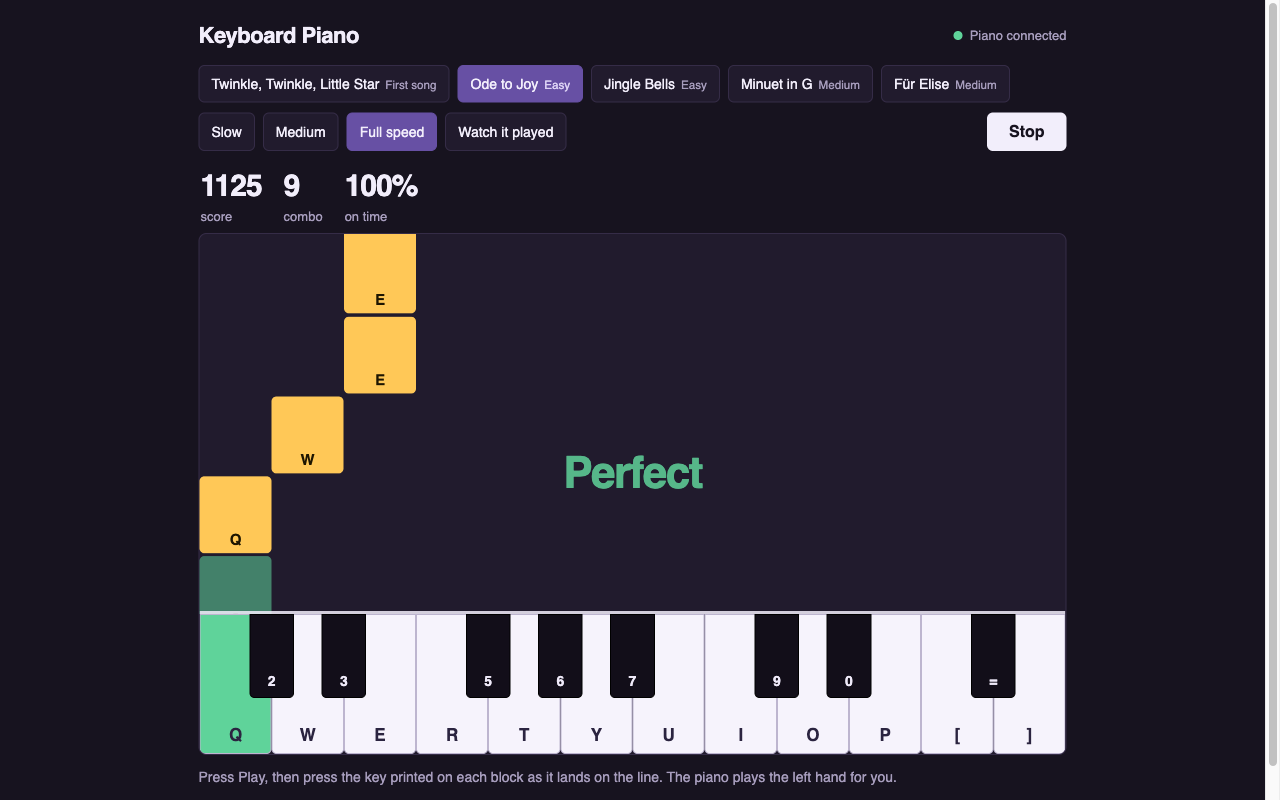
Your keyboard becomes a piano with chords, sustain and octave shift. A lessons page in your browser teaches five songs.

Files

tools/synth.py

#!/usr/bin/env python3
"""Regenerate samples/<midi>.ogg for Keyboard Piano.

A physical-ish piano model in pure Python, encoded to Ogg Vorbis by ffmpeg:

- every note is a stack of stiff-string partials, stretched sharp by an
  inharmonicity that grows up the keyboard, as many as fit under Nyquist
- the hammer strikes an eighth of the way along the string, which notches
  every eighth partial, and its felt rolls the spectrum off
- each partial decays in two stages, a fast attack decay and a long
  aftersound, and upper partials die sooner
- two or three strings per note, unequal and slightly out of tune, so the
  tone shimmers without ever beating down to silence
- a few milliseconds of filtered noise for the hammer knock

48 kHz mono, so the usual 48 kHz output device plays it without resampling.

    python3 tools/synth.py            # writes ./samples, needs ffmpeg
    python3 tools/synth.py out_dir
"""

import array
import math
import multiprocessing
import os
import random
import subprocess
import sys
import tempfile
import wave

RATE = 48000
LOW, HIGH = 36, 91  # C2..G6: the key map's range across every octave shift
HAMMER_AT = 0.125
PEAK = 0.85
VORBIS_QUALITY = "4"


def note_seconds(midi):
    # bass strings ring longest: 4.0 s at the bottom, 1.5 s at the top
    return 4.0 - 2.5 * (midi - LOW) / (HIGH - LOW)


def add_partial(out, freq, amp, t60, phase):
    """Add amp * exp(-t/tau) * sin(w t + phase) by a two-multiply recurrence."""
    w = 2 * math.pi * freq / RATE
    r = math.exp(-math.log(1000) / (t60 * RATE))
    c, r2 = 2 * r * math.cos(w), r * r
    y2 = amp * math.sin(phase - w) / r
    y1 = amp * math.sin(phase)
    for i in range(len(out)):
        out[i] += y1
        y1, y2 = c * y1 - r2 * y2, y1


def render(midi):
    rng = random.Random(midi)
    f0 = 440.0 * 2 ** ((midi - 69) / 12)
    n = int(RATE * note_seconds(midi))
    out = [0.0] * n

    up = (midi - LOW) / (HIGH - LOW)  # 0 at the bottom of the range, 1 at the top
    stiffness = 2e-4 * 2 ** ((midi - 48) / 12 * 1.2)
    felt = 2400 + 1800 * up  # Hz: where the hammer's spectrum has fallen by 1/e
    sustain = 11.0 * 2 ** (-2.6 * up)  # seconds for the fundamental's aftersound to fall 60 dB
    strings = [(0.0, 1.0)] if midi < 40 else [(0.0, 1.0), (0.7, 0.7)]
    if midi >= 48:
        strings.append((-1.0, 0.5))

    k = 1
    while k <= 64:
        stretched = k * f0 * math.sqrt(1 + stiffness * k * k)
        if stretched > RATE * 0.42:
            break
        amp = abs(math.sin(k * math.pi * HAMMER_AT)) * math.exp(-stretched / felt) / k**0.8
        if amp > 1e-4:
            t60 = sustain / (1 + 0.14 * (k - 1))
            for cents, weight in strings:
                freq = stretched * 2 ** (cents / 1200)
                phase = rng.uniform(0, 2 * math.pi)
                add_partial(out, freq, amp * weight * 0.7, t60 * 0.3, phase)
                add_partial(out, freq, amp * weight * 0.3, t60, phase)
        k += 1

    # the hammer knock: a short burst of low-passed noise
    body = max(abs(s) for s in out)
    smooth = math.exp(-2 * math.pi * (900 + 2500 * up) / RATE)
    low = 0.0
    for i in range(int(RATE * 0.03)):
        low = smooth * low + (1 - smooth) * rng.uniform(-1, 1)
        out[i] += 0.5 * body * low * math.exp(-i / (RATE * 0.006))

    attack, release = int(RATE * 0.002), int(RATE * 0.08)
    for i in range(attack):
        out[i] *= 0.5 - 0.5 * math.cos(math.pi * i / attack)
    for i in range(release):
        out[n - 1 - i] *= i / release

    scale = PEAK * 32767 / max(abs(s) for s in out)
    return array.array("h", (int(s * scale) for s in out))


def write_note(job):
    midi, out_dir, tmp = job
    pcm = render(midi)
    if sys.byteorder == "big":
        pcm.byteswap()
    wav = os.path.join(tmp, f"{midi}.wav")
    with wave.open(wav, "wb") as f:
        f.setnchannels(1)
        f.setsampwidth(2)
        f.setframerate(RATE)
        f.writeframes(pcm.tobytes())
    subprocess.run(
        ["ffmpeg", "-v", "error", "-y", "-i", wav, "-c:a", "libvorbis", "-q:a", VORBIS_QUALITY,
         "-map_metadata", "-1", "-fflags", "+bitexact", os.path.join(out_dir, f"{midi}.ogg")],
        check=True,
    )
    return f"{midi}.ogg  {len(pcm) / RATE:.2f} s"


def main():
    out_dir = sys.argv[1] if len(sys.argv) > 1 else "samples"
    os.makedirs(out_dir, exist_ok=True)
    with tempfile.TemporaryDirectory() as tmp, multiprocessing.Pool() as pool:
        jobs = [(midi, out_dir, tmp) for midi in range(HIGH, LOW - 1, -1)]
        for line in pool.imap_unordered(write_note, jobs):
            print(line)


if __name__ == "__main__":
    main()

56 files without text previews